
UV/Visible Dispersive Mirrors
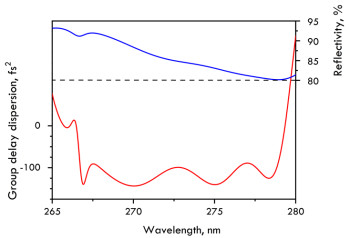
A dispersive mirror is an optical component used for pulse compression and dispersion compensation, capable of modulating the temporal and spectral properties of laser pulses through reflection to achieve the desired pulse duration. It is widely applied in ultrafast laser systems, especially where ultrashort pulse compression is required. Dispersive mirrors operating in the UV and visible ranges are often employed in broadband pulse compression applications such as laser spectroscopy, ultrafast imaging, and material processing.
Since UV and visible lasers are frequently used under extreme experimental conditions, the design of dispersive mirrors requires exceptional damage resistance and optical performance. These mirrors are characterized by broadband dispersion compensation, compatibility with UV and visible laser sources, and optimized pulse compression and temporal control for high-precision ultrafast laser applications.
800nm Dispersive Mirrors
A dispersive mirror is an optical component designed for pulse compression and dispersion compensation, capable of modulating the temporal and spectral characteristics of laser pulses through reflection to achieve the desired pulse duration. It is widely used in ultrafast laser systems, especially when sub-100fs pulse compression is required.
The 800nm dispersive mirror is typically used in Ti:Sapphire femtosecond laser systems, one of the most common ultrafast laser sources, broadly applied in ultrafast optics research, material processing, and biomedical imaging. By precisely compensating pulse dispersion, the 800nm dispersive mirror optimizes temporal characteristics and ensures the highest time resolution in experiments. Its key features include high reflectivity (>99.9%), strong dispersion compensation capability, and compatibility with ultrashort pulses (<100fs), making it ideal for laser microscopy, ultrafast imaging, and precision micromachining applications.
1030nm Dispersive Mirrors
A dispersive mirror is an optical component used for pulse compression and dispersion compensation, capable of modulating the temporal and spectral properties of laser pulses through reflection to achieve the desired pulse duration. It is widely applied in ultrafast laser systems, especially where high temporal precision and short pulse durations are required. The 1030nm high-dispersion dispersive mirror is typically used in ytterbium-based laser systems, designed to compensate for the dispersion caused by optical components and media during pulse propagation.
Since 1030nm is the operating wavelength of many ultrafast lasers, this mirror effectively optimizes pulse shape and minimizes temporal broadening. Its key features include high dispersion compensation capability, high reflectivity, low absorption, and precise temporal control, making it ideal for high-power femtosecond laser systems used in applications such as precision micromachining, ultrafast spectroscopy, and nonlinear optics experiments.
1300-2000nm Dispersive Mirrors
A dispersive mirror is an optical component used for pulse compression and dispersion compensation, capable of modulating the temporal and spectral properties of laser pulses through reflection to achieve the desired pulse duration. It is widely applied in ultrafast laser systems, particularly when sub-picosecond pulse compression is required. The 1300-2000nm dispersive mirror is designed for laser applications with wavelengths above 1μm.
This type of mirror is optimized for temporal compression and frequency modulation of laser pulses to enhance overall system performance. Suitable for the mid-infrared spectral region, it features high dispersion compensation capability, high reflectivity, low loss, and excellent durability under high-energy laser conditions. Typical applications include mid-infrared LiDAR, gas sensing, and laser drilling or cutting, where precise pulse shaping and efficient energy control are critical.
2000-5000nm Dispersive Mirrors
A 2000-5000nm dispersive mirror is an optical component specifically designed for the mid-infrared spectral range, widely used in femtosecond laser systems. It is particularly suited for experiments requiring broadband wavelength control, enabling precise adjustment of a laser pulse’s spectral and temporal characteristics. By compensating for group delay dispersion (GDD), the mirror compresses or stretches pulse duration to improve temporal resolution or tailor pulse shape. Its high-precision optical design ensures excellent surface flatness and minimal optical loss, allowing accurate and efficient pulse transmission.
Utilizing advanced high-performance coating technologies—such as high-reflection and anti-reflection coatings—the 2000-5000nm dispersive mirror provides exceptional reflectivity and stability under high-power laser operation. It maintains long lifetime and reliable reflection efficiency across a broad wavelength range and high-intensity conditions. This makes it an indispensable optical element for mid-infrared femtosecond laser systems, significantly enhancing experimental precision and efficiency
Reviews
There are no reviews yet.